Why AI projects fail
Why most enterprise AI projects fail — and the discipline that fixes it
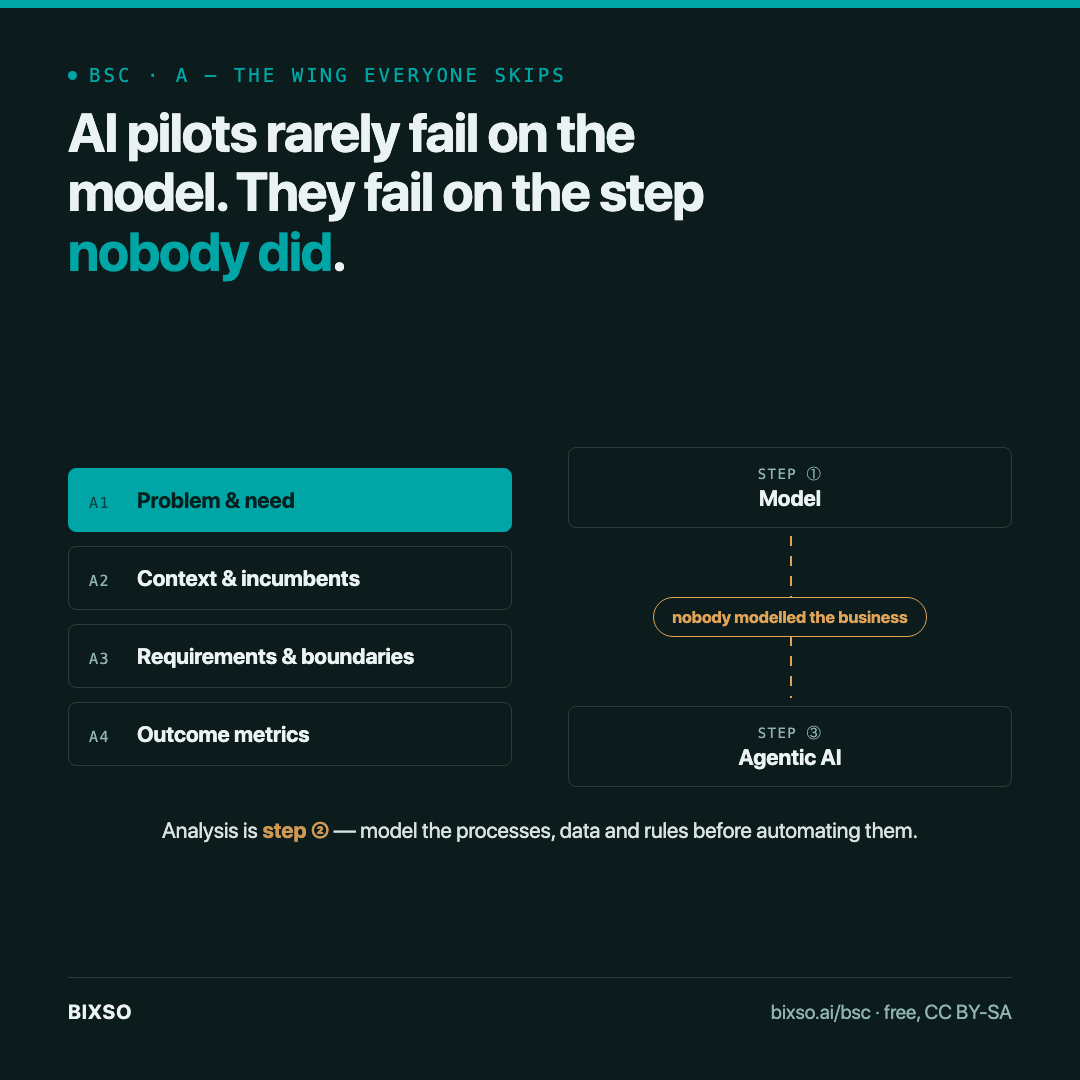
Most AI pilots don't fail because the model is weak. They fail because nobody modelled the business first. The fix is an old discipline — business analysis — applied before any automation.
Ask a room of executives how their last AI initiative went, and you’ll get the same shape of answer: a promising demo, a stalled rollout, and a quiet write-off. The instinct is to blame the technology. The technology is rarely the problem.
Most enterprise AI fails for an unglamorous reason: nobody modelled the business before automating it. The model was fluent. It just didn’t understand how the business actually works — its real processes, its data, its rules, the decisions that can’t be got wrong. So it sounded confident, and it was confidently wrong exactly where it mattered.
The demo trap
A demo runs on the happy path. A business runs on the edge cases — the exception that voids the warranty, the rule that can’t be traded away, the approval that must involve a human. General AI is broad and shallow: it knows a little about everything and not enough about your one thing. Drop it into a real workflow and the gap shows immediately.
This is why “add an AI chatbot” so often underdelivers. The chatbot isn’t grounded in anything. It has no model of the work.
The missing step
The step that gets skipped is business analysis — the discipline of modelling the real processes, data and rules of a business before building anything on top of them. It’s not a buzzword; it’s the foundation the whole system stands on.
Done properly, it decodes a business into four strands:
- Processes — the actual flow of work, including the exceptions.
- Data — what’s held, in what shape, with what gaps.
- Rules — the hard constraints that can never be bent, and the soft preferences that can.
- Decisions — which calls can be automated, which need a human, and which must never be auto-approved.
Pair those strands, and you have a model precise enough to automate without breaking. Skip them, and you have a confident system with no idea where the cliffs are.
What good looks like
The order matters. Strategy first, rigour next, autonomy last:
- Business model — start from how value is created and captured. Business first, technology second.
- Business analysis — model the processes, data and rules with rigour. This is the part most projects skip.
- Agentic AI — only then build: autonomous AI that plans, decides and executes within guardrails.
An AI built in that order can act on its own without going wrong, because the analysis told it where the guardrails are. It shows its sources, shows its confidence, and asks a human when it isn’t sure — rather than guessing.
What this means for a leader
If you’re evaluating an AI vendor, the question isn’t “how big is your model.” It’s “show me how you’d model our business before you build.” A vendor who leads with the architecture has skipped the step that decides whether the thing works.
The good news: this is a solved discipline. It just has to be applied — before the automation, not after the pilot fails.
Specialist, not generalist. We use big models to build small, sharp ones for each industry — grounded in business analysis.
That’s the BIXSO method, and every product we ship is the proof of it. If you want AI that goes deep on your business instead of broad across everyone’s, book a consult — we start with the questions, not the tech.