Specialist vs generalist AI
Specialist vs generalist AI — why a small, sharp model beats a big general one
A general model knows a little about everything. For a real business, that's the wrong trade. The future of useful AI is deep, not broad.
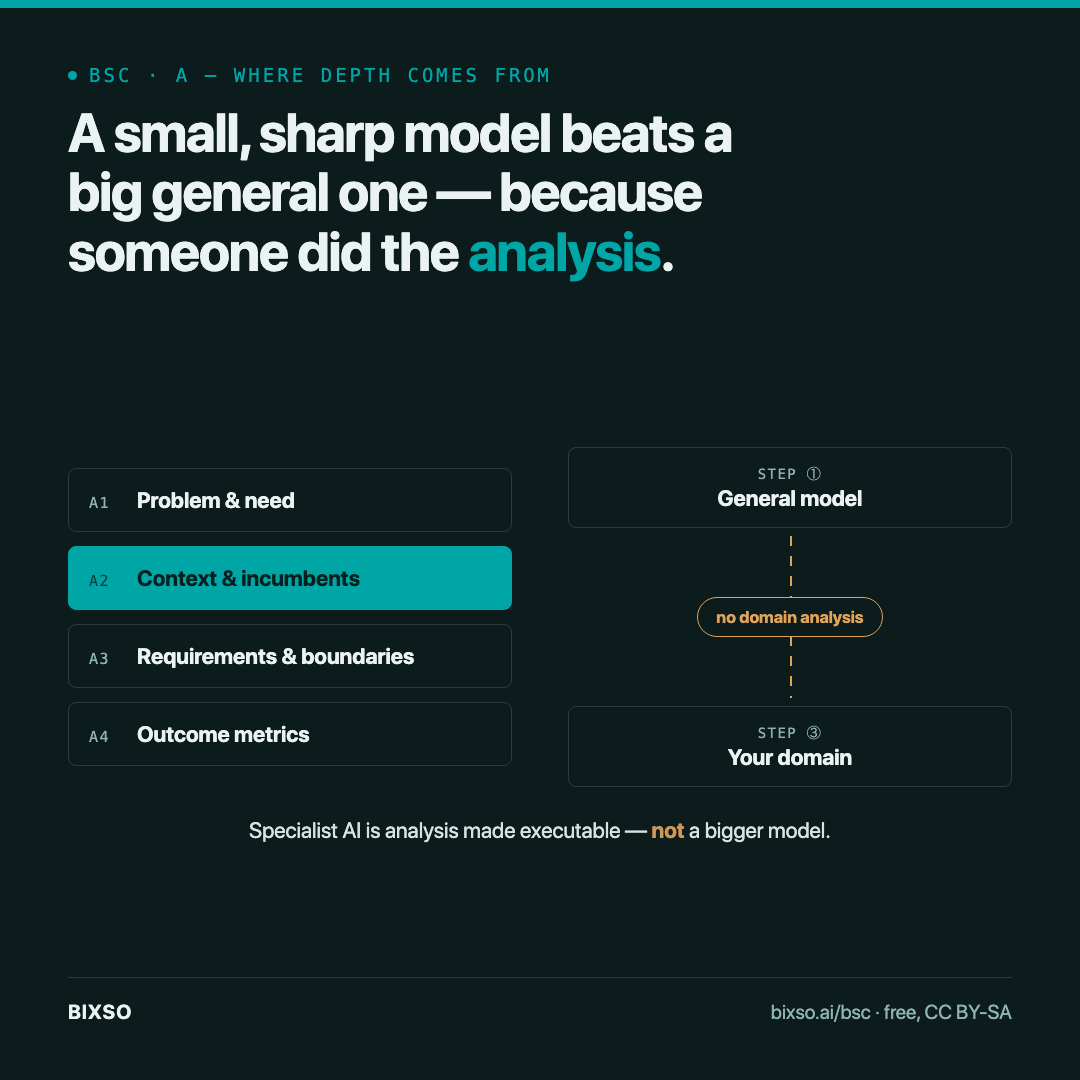
There’s an assumption baked into most AI buying decisions: bigger is better. The biggest general model must be the smartest choice. For a real business, it usually isn’t.
A general model is broad and shallow — it knows a little about everything, and not enough to run your operation. It’s impressive in a demo and vague in production, because production is specific. Your business doesn’t run on averages; it runs on its own processes, its own data, its own rules.
Big in, sharp out
The better trade is to go the other way. Use the big models as raw material — and from them, build a small, specialised one for a single industry.
That’s the engine: analyse a domain rigorously, then use large models to train a focused model — an SLM, a small language model — that deeply understands one field. Governed, focused, deep. One model that understands sourcing, or health, or sport — instead of one that vaguely understands all three.
Why depth wins
- It’s right where it counts. Trained on the real workflow, it handles the edge cases a general model fumbles.
- It’s governable. A narrow, well-understood model is far easier to constrain, audit and trust.
- It’s cheaper to run and faster. Small and specialised beats large and general on cost and latency.
- It’s proven. A specialist model becomes a shipped, vertical product — not a science project.
The takeaway
The question to ask isn’t “how large is the model.” It’s “how deeply does it understand my business.” Depth beats breadth wherever the work is real.
That’s why every BIXSO product is a domain model plus business analysis — a deep, specialist AI for its field. See our work, or book a consult.